
Releem: Schema Optimization tool for MySQL & MariaDB






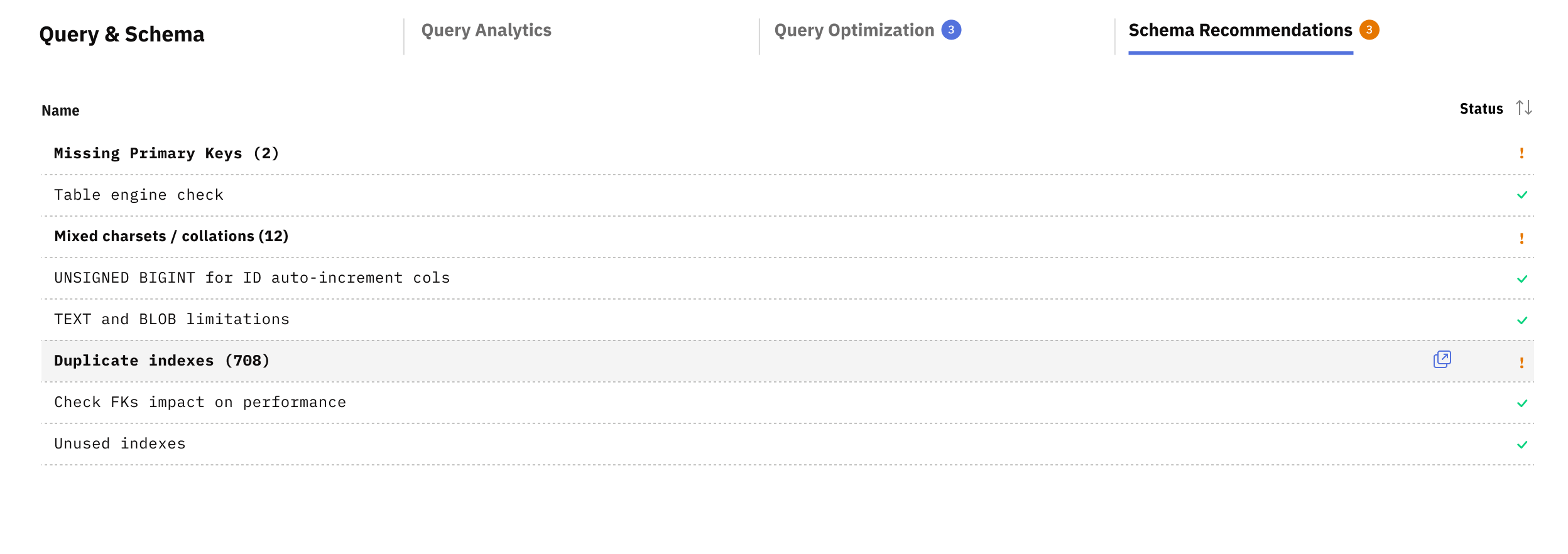



Schema optimization means ensuring your database tables, indexes, keys, collations, and storage engines are designed so that queries run efficiently and the system remains reliable under load. This applies not only to your current workload but also to future scaling, maintainability, and long-term performance.
Poor schema design can lead to slow queries, excessive I/O, difficult migrations or schema changes, wasted storage, and data-integrity problems. Automating schema reviews helps detect such structural issues early, before they become costly or disruptive.
Poor schema design can lead to slow queries, excessive I/O, difficult migrations or schema changes, wasted storage, and data-integrity problems. Automating schema reviews helps detect such structural issues early, before they become costly or disruptive.
What Are Schema Checks?
Schema Checks are the basic steps used to review a database structure. They examine tables, columns, keys, indexes, and relationships to confirm that everything is designed correctly and follows good database practices. This is the same process you would go through when manually checking whether a database is built in a clean, efficient, and reliable way.
Releem automates these checks. It continuously reviews your schema for issues such as missing primary keys, incorrect data types, redundant or unused indexes, missing foreign keys, and other structural problems that can affect performance or data integrity. This helps keep your database in good shape without manual effort.
Releem automates these checks. It continuously reviews your schema for issues such as missing primary keys, incorrect data types, redundant or unused indexes, missing foreign keys, and other structural problems that can affect performance or data integrity. This helps keep your database in good shape without manual effort.

Releem automates the following Schema Checks to keep your database structure efficient and consistent:
- Primary Key Check (Missing Primary Keys) - Verifies that each table has a primary key, which is crucial for unique row identification and efficient query performance.
- Table Engine Check (Deprecated Table Engine) - Flags tables using outdated storage engines, such as MyISAM, and recommends migration to InnoDB for enhanced performance and reliability.
- Table Collation Check (Mixed Collations) - Detects mixed collations across tables or columns, which can lead to performance issues during string comparisons and joins.
- Table Character Set Check (Mixed Character Set) - Identifies mismatched character sets that may lead to data inconsistency or encoding issues.
- Column Auto Increment Check (Type of Auto Increment Columns) - Ensures that auto-increment columns are appropriately defined to prevent potential data insertion errors.
- Table Foreign Key Check (Existence of Foreign Keys) - Confirms the presence of foreign keys where necessary to maintain referential integrity between related tables.
- Duplicated Index Check - Identifies redundant indexes that can negatively impact performance and increase storage requirements.
- Unused Index Check - Detects indexes that are not utilized by queries, suggesting their removal to optimize performance.
Automated and Effortless Optimization
Releem runs schema checks automatically every day and updates your dashboard with any issues it finds. There is no need to manually review tables or maintain custom scripts to track schema problems. Releem alerts you when something changes or requires attention, giving you a continuous, reliable view of schema health without extra work.
More than Schema Checks
Releem provides a full set of MySQL management capabilities in addition to Schema Checks:
- Health Checks – Twice daily evaluations of 19 different metrics to reveal important information about your database's overall condition.
- MySQL Monitoring – Releem is constantly monitoring your database metrics, to spot potential performance issues as they emerge, giving you peace of mind.
- Automatic Configuration Tuning – Releem identifies and pinpoints areas where your database needs improvement, offering tailored MySQL configuration suggestions that are implementable at the click of a button.
- Automatic SQL Query Optimization and Index Suggestions – Releem automatically identifies inefficient queries and suggests missed indexes.
Get your own database advisor
Try Releem premium today for FREE!
Try Releem premium today for FREE!